
- Imprimer
- Partager
- Partager sur Facebook
- Partager sur LinkedIn
The team
The project allowed the collaboration between different researchers from three French laboratories and one in Spain, as well as with anaesthesiologists of the CHU Grenoble Alpes.
Bob Aubouin–Pairault, PhD student at Gipsa-lab, Univ. Grenoble Alpes, Grenoble
Daniel Denardi Huff, post-doctoral researcher at Gipsa-lab, Univ. Grenoble Alpes, Grenoble
Benjamin Meyer, intern at Anesthesia and Critical Care Medicine Unit at CHU Grenoble Alpes
Mirko Fiacchini, CR CNRS, Gipsa-lab, Univ. Grenoble Alpes, Grenoble
Thao Dang, DR CNRS, Verimag, Univ. Grenoble Alpes, Grenoble
Kouther Moussa, associate professor at INSA Hauts-de-France, LAMIH, Valenciennes
Remi Wolf, Univ. Grenoble Alpes, Department of Anaesthesia and Critical Care, Grenoble
Mazen Alamir, DR CNRS, Gipsa-lab, Univ. Grenoble Alpes, Grenoble
Teodoro Alamo, Full professor University of Seville, Spain
In particular, the PERSYVAL-lab project funded the positions of B. Aubouin–Pairault and D.D. Huff.
The objective
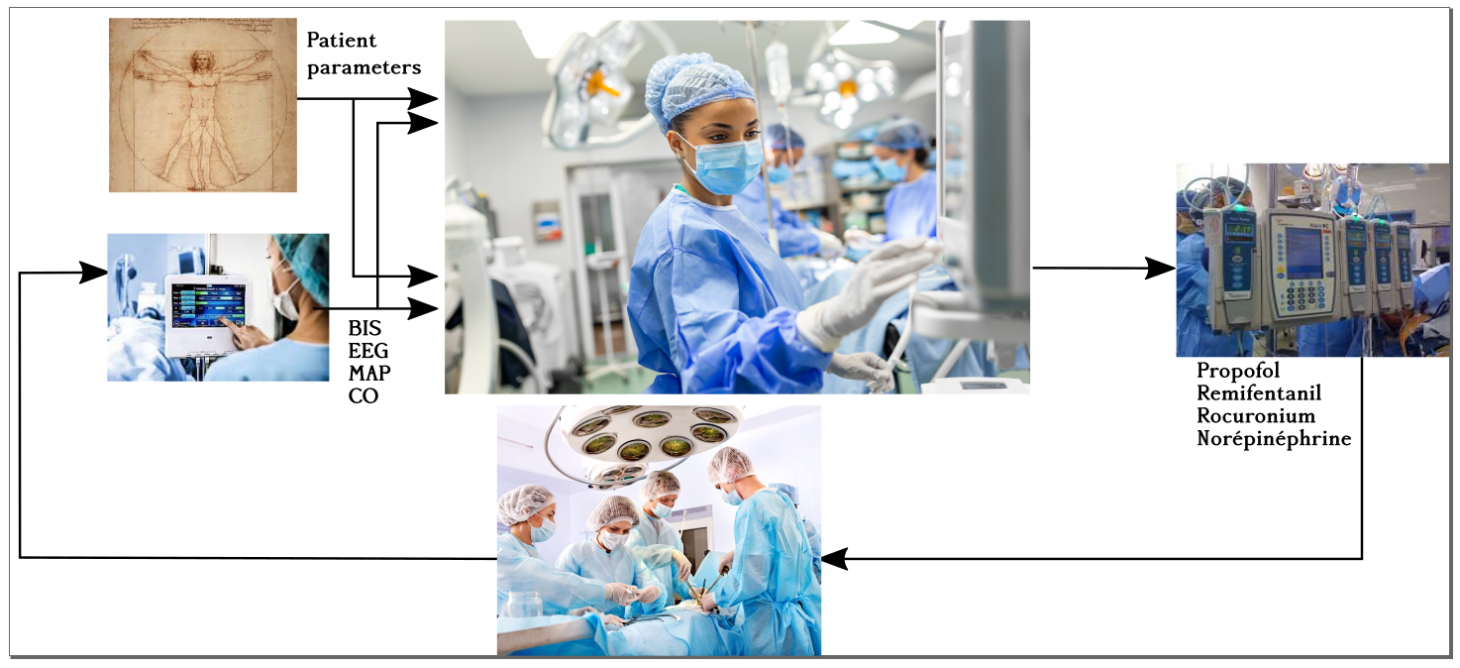
General anesthesia plays a fundamental role to provide surgeons with adequate conditions for operation and avoid discomfort or pain for the patient while reducing the negative post-operation effects of anesthesia. In medical practice, anesthesia concerns the monitoring and controlling of the evolution of the areflexia (lack of movement), analgesia (lack of pain) and hypnosis (lack of consciousness) of the patient. Based on several physiological signals, like the Bispectral Index (BIS), the electroencephalogram (EEG) and the pain and neuromuscular blockage indicators, the anesthesiologist modulates the different drugs perfusion rates to reach and maintain the adequate anesthesia levels. Besides controlling the patient’s sedation level, the anesthesiologist is designated to monitor the hemodynamic state, measured by the mean arterial pressure (MAP) and the cardiac output (CO), since the cardiovascular system strongly interacts with the multi-drug anesthesia process.
The main objective of anesthesia is to maintain the desired level of hypnosis, areflexia and analgesia to facilitate the surgeon’s tasks by avoiding both drug overdosing and underdosing and their potentially extremely severe consequences on the patient. Pursuing this aim, automatic feedback control theory, formal verification and machine learning can be of great help not only to increase the control efficiency and the monitoring reliability, but also to preserve the vigilance of anesthetists on potential critical events. Several sources of complexity, though, contribute to make the problem of monitoring, predicting and controlling the anesthesia process extremely challenging. Although some works have been appearing proposing automatic control application to the anesthesia process, several key issues are worth to be further addressed.
This research project aims at exploiting the potentialities of advanced control theory, formal verification and machine learning techniques to design and implement optimization and computation-oriented methods
to assist the anesthesiologist during surgery. The main challenges to be addressed are the high uncertainty affecting the system dynamics, its variability in time and from patient to patient, the high risk sensitivity of the application, the necessity of accurate validation and certification of the proposed solution and the often partial information on the evolution of such a complex process. The access to real surgery operation data have a central role for developing, applying and validating the proposed techniques, whose real-time embedded implementation is the ultimate objective. The computational and implementation constraints inherent to the cyber-physical nature of the proposed anesthesiologist assistance are carefully considered in the theoretical developments.
Work methods or means
Hereafter, a brief overview is presented on the theoretical and computational tools employed to address the problems of monitoring, controlling and predicting the patients physiologic state during the surgery anesthesia process.
- Machine learning: In the last years, scientific research witnessed a stunning explosion of popularity of artificial intelligence methods, whose aim could be summarized as a set of computational techniques that are able to simulate on digital devices the learning process proper of living beings. The widespread availability of huge data sets and the increasing computational power of modern devices, together with their proved efficiency, substantially contributed to make these techniques accessible and to promote their application in many industrial and scientific contexts. Machine learning methods are a class of techniques whose objective is to infer properties of data as a result of an optimization problem solutions, in particular, the estimation of unknown functional relation between some data input and the related output, i.e. the regression problem, or a discrimination criterion for the data, the classification problem.
- Moving horizon observers: Theory of observability for nonlinear dynamical systems had attracted the attention of researcher since several decades and the proposed solutions evolved along the time. A popular approach, alternative to classical observer methods, appeared recently aimed at the practical application of observers to real systems and data-based processes, that define the moving horizon observer paradigm. These family of approaches aims substantially to achieve the fundamental estimation objective of a reduction of the observation error as the result of an online optimization problem solution. Among the main benefits of moving horizon observers we find a much smaller dependence on structural assumptions on the system and a more direct capability for handling parameter uncertainties, partial lack of knowledge on the dynamics, presence of noises and of constraints. At the price of a more involved online computational burden, moving horizon observers, that can be seen as the observation dual of model predictive controllers, provide a rather effective and more data-based approach to estimate the state in real systems context.
- Model Predictive Control: Model Predictive Control is a control technique whose popularity mostly relies in its capability of dealing with constraints and of ensuring performance optimization and in its suitability for practical application, by guaranteeing, at the same time, desirable stability properties. The inherent MPC aim of real implementation of control led to focus on the effects of model uncertainties, disturbances and noises on the control performances and stability, yielding to robust and stochastic formulations of MPC, besides the deterministic one. Recently, in order to reduce the conservatism by exploiting the statistical structure of the uncertainty, stochastic MPC has attracted the researchers attention. In this framework the stochastic features of the state predicted evolution can be taken into account and hard constraint can be relaxed in terms of chance constraints satisfaction.
Results
Different scientific challenges have been addressed in the framework of the DAMon project:
- Modelling: using the available datasets together with the theory of control and the learning tools we have been working to propose new and more accurate models, in particular:
- data-based machine learning models
- on-line joint state estimation and parameter identification
- Automatic drug control: we have been proposing new closed-loop methods to dose drugs during general anesthesia and improve the performance with respect to the current state of the art
- Critical events detection and forecast: machine learning and data-based methods have been applied for hypotension prediction
- CHUGA data annotation: the problem of processing the database, for relevant alarms determination to be used for alert generators for surgery, has been considered.
Leverage effect
The project provided to opportunity of create scientific connections and collaboration with two international groups that are leader in the research of control for anesthesia dynamics, in particular with the team of Prof. C. Ionescu at the University of Ghent, Belgium and Prof. Visioli at the University of Brescia, Italy. In this context, B. Aubouin-Pairault have been spending one month in Ghent.
The collaboration lead to a joint workshop on the topic in Grenoble, in December 2024, the joint publication of a state-of-the-art simulator of anesthesia dynamics and the associated Journal publication, current under revision.
The 5 main publications
B. Aubouin-Pairault, M. Fiacchini, T. Dang, (2024) Online identification of pharmacodynamic parameters for closed-loop anesthesia with model predictive control, Computers & Chemical Engineering, 191, 108837.
B. Aubouin-Pairault, M. Fiacchini, T. Dang, (2024) Data-based modeling of the Pharmacodynamics for the effect of Propofol and Remifentanil during General Anesthesia, Biomedical Signal Processing and Control, 98, 106728.
B. Aubouin-Pairault, M. Fiacchini, T. Dang, (2024) Comparison of multiple Kalman filter and moving horizon estimator for the anesthesia process, Journal of Process Control, 136, 103179.
D. D. Huff, M. Fiacchini, T. Dang, T. Alamo, (2024) Optimized coadministration of propofol and remifentanil during the induction phase of total intravenous anesthesia with statistical validation, IEEE Control Systems Letters, 8, 193-198.
K. Moussa, B. Aubouin-Pairault, M. Alamir and T. Dang, "Data-Based Extended Moving Horizon Estimation for MISO Anesthesia Dynamics," in IEEE Control Systems Letters, vol. 7, pp. 3054-3059, 2023
- Imprimer
- Partager
- Partager sur Facebook
- Partager sur LinkedIn