
Control Techniques for Autonomous Smart Environments
- Share
- Partager sur Facebook
- Partager sur LinkedIn
Exploratory project
Background
This project brought together members from Inria, LIG, Gipsa-lab, and CEA LETI/DACLE and focused on the general theme of control techniques for autonomous intelligent environments, with a particular emphasis on linking discrete and stochastic control models with middleware platforms applied to intelligent environments. It enabled us to hire two Master’s students for 2016.
Scientific results obtained
A service-oriented approach to controlling smart home applications using reactive programming
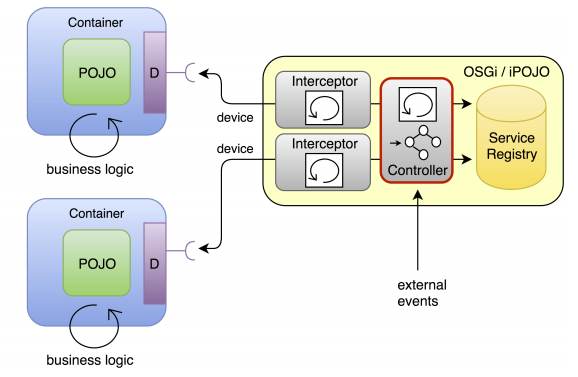
This work constituted Armando Ochoa’s M2R internship and was carried out in collaboration with the Adele team at LIG, under the joint supervision of E. Rutten and V. Lestideau. The need for adaptability in the field of ubiquitous computing (or distributed computing) is becoming increasingly important, particularly due to the growing number and variety of communication devices. In autonomous applications, however, the control architecture itself often becomes a complex system that must be adapted. Autonomous applications are often composed of multiple control loops—each addressing a specific aspect—whose execution must be coordinated for effective and correct management. We therefore propose to study the use of reactive control models with events and states to coordinate autonomous loops in service-oriented architectures. In this work, we illustrate our approach by integrating a controller based on discrete controller synthesis into a pervasive autonomous environment. The controller’s role is to influence the service binding criteria of multiple control loops, while adhering to logical constraints. In particular, we consider reconfiguration operations for sets of known and dynamic services.
Multi-objective optimal reconfiguration of a smart home platform
This work constituted Ronak Feizimirkhani’s M2R internship, co-supervised by S. Mocanu and V. Lestideau. The context is the development of an application for a smart home in which automation devices are connected via a wireless communication protocol, Z-Wave, and controlled by a central USB plug-in controller. This involves methods and tools for designing safety-critical controllers for autonomous, adaptive, and reconfigurable computer systems by combining techniques from computer science and control theory. To this end, it is necessary to access the required information on the network, derive a simplified model of the physical network, and then link it to the user interface application. Based on the information obtained, it will be possible to estimate network diagnostics and identify likely solutions. The final application takes the form of a user interface that enables the installation, maintenance, or even optimization of the network and devices.
Publications
- Armando Ochoa. A service-oriented approach to controlling smart home applications using reactive programming. Master’s thesis, UGA, Grenoble, France, 2016.
- Ronak Feizimirkhani. Multi-Objective Optimal Reconfiguration of a Smart Home Platform. Master’s Thesis, UGA, Grenoble, France, 2016.
- Share
- Partager sur Facebook
- Partager sur LinkedIn