
Simulation of vortex dynamics in flow at moderate Reynolds numbers
- Share
- Partager sur Facebook
- Partager sur LinkedIn
Exploratory project
Fundamental studies on vortex generation, its dynamics, and its consequences for flows at moderate Reynolds numbers (100 ≤ Re ≤ 20,000)—such as sound production—are rare. To contribute to the understanding of such flows in laminar, turbulent, and transitional regimes, the current project aims to simulate well-defined geometric and initial conditions that allow for validation against simulated and/or experimental data. Furthermore, these phenomena are of fundamental interest and play a critical and/or enjoyable role in everyday life (breathing, speech production, wind instruments, whistling, etc.).
Motivation and Background
1. The Need to Study Flows at Moderate Reynolds Numbers
The generation of vortices, their dynamics, and their consequences—such as the noise they produce and their interaction with downstream structures—are primarily studied under flow and geometric conditions corresponding to those encountered in industrial applications, such as in aerospace engineering. Consequently, most studies—whether theoretical, computational, or experimental—focus on carefully designed flow and geometric conditions that ensure laminar or turbulent flow without transition. Furthermore, they primarily consider flows with high Reynolds numbers, i.e., Re >10⁴.
It is clear that flow control mechanisms, such as the initial thickness of the boundary layer or the initial turbulence intensity, are absent from vortex generation in nature (see Figure 1). Consequently, vortex generation can occur naturally in both confined and free flows.
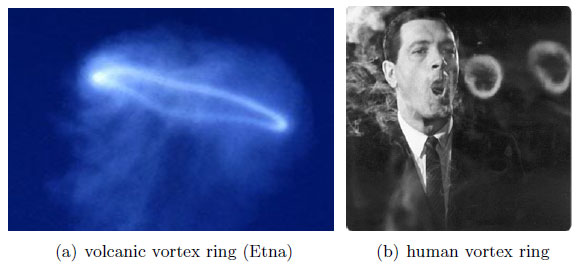
Dans le cas où les conditions initiales ne sont pas contrôlées, en particulier avec des nombres de Reynolds modérés (102 < Re < 104), la transition d'un régime d'écoulement laminaire à un régime d'écoulement turbulent lorsque le nombre de Reynolds augmente est hautement probable et dépendra des propriétés du fluide et des conditions initiales : profil de vitesse moyenne, intensité de turbulence ou propriétés de turbulence.
From the perspective of fluid dynamics and related fields, such as aeroacoustics, there is a need for fundamental studies focusing on:
- Flow at moderate Reynolds numbers,
- Laminar, turbulent, and transient flow regimes.
The normal flow of air through the human upper airways is due to physiological and anatomical properties characterized by velocities and geometric scales that are, compared to air flows studied in other areas of biofluidics: small when compared to geophysical or even cosmic flows, and large when compared to the dimensions and velocities encountered in algal or bacterial biofluids. Consequently, the typical Reynolds numbers encountered in flow through the upper airways are on the order of10³, which corresponds to flow at moderate Reynolds numbers. Consequently, the study of flow at moderate Reynolds numbers is of fundamental interest, largely driven by life-essential applications such asrespiratory flow through the human airways, as well as the production of human speech sounds, wind instruments, and whistling. Several authors [1, 6] have recently highlighted the need for flow data, whether simulated or experimental.
Consequently, from both a fundamental and a biofluidics perspective, it is necessary to study flows at moderate Reynolds numbers. In this project, the focus is on vortex generation and dynamics for laminar, turbulent, and transitional flow regimes.
2. Study of vortex flows at Gipsa-lab and LJK and potential synergies
The GAMA team at Gipsa-lab focuses its research on aeroacoustics and fluid-structure interaction for applications related to the human respiratory tract, such as speech production. As such, this research involves physical modeling, simulation, and experimental validation and characterization using mechanical replicas. Since vortex dynamics is closely linked to sound production, this exploratory project has sparked keen interest among the researchers involved.
Over the past fifteen years, the LJK has developed expertise in direct, large-scale simulations of turbulent flows using vorticity particle methods. This has notably earned the LJK several invitations to the Center for Turbulence Research at Stanford, one of the world’s leading groups in this field. It is worth noting that the LJK has recently established a collaboration with LEGI in Grenoble, but collaborations within PERSYVAL-Lab represent a new avenue we wish to explore in the field of flow simulation. These collaborations could extend to fluid-structure interactions, where the LJK has recently been actively developing several research areas—again, with collaborations that have so far been limited to research teams outside of PERSYVAL-Lab. LJK is also developing, in collaboration with LEGI, a new high-performance computing framework based on vorticity particle methods using modern paradigms (GPUs, hybrid computing).
Objective
Natural flow paths, such as the human upper respiratory tract, are strongly influenced by complex geometries with varying wall properties, as illustrated in Figure 2(a).
Consequently, mathematical and physical studies require significant simplifications of real-world geometry, as illustrated in Figure 2(b), in order to grasp the underlying principles and conduct in-depth, repeatable studies with a limited number of parameters.
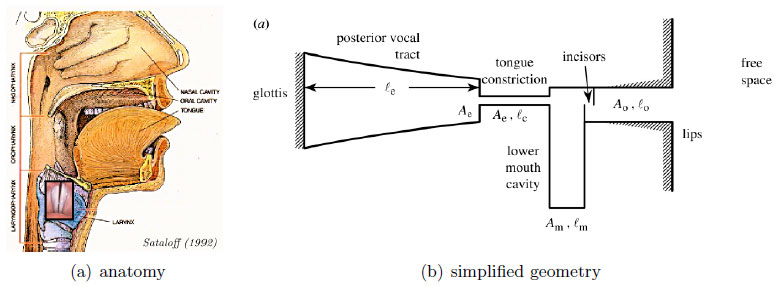
Figure 2 (b): Vortex generation due to the wrapping of the shear layer occurs both in confined jet flow—for example, immediately downstream of the obstacle—and in free jet flow—for example, downstream of the outlet. Published studies allow for the formulation of several scientific objectives [9, 8, 7, 5].
In this exploratory project, an in-depth characterization and modeling of air flow aim to identify the onset of flow instabilities, vortex entrainment, and coherent structures in free-jet and jet-obstacle interactions as a function of the Reynolds number, emitter geometry, flow perturbation, and boundary conditions, with particular attention paid to the transition regime.
Approach
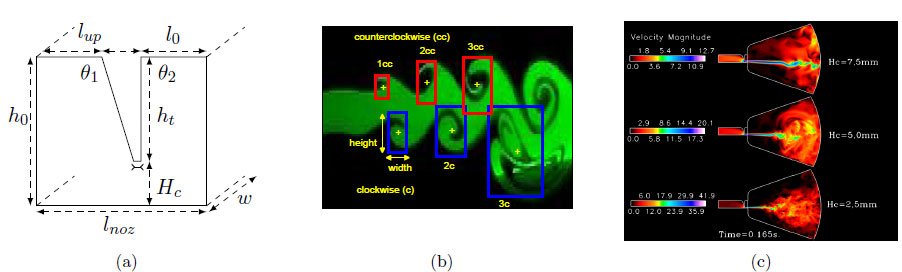
An example of simplified geometry is shown in Figure 3(a). Despite its apparent simplicity, there are numerous key geometric parameters that influence the jet dynamics. The minimum opening Hc and the upstream angle θ1 determine the flow acceleration induced by the obstacle and, consequently, the asymmetry of the velocity profile at the tip of the obstacle. Furthermore, the distance l0 downstream of the obstacle to the nozzle outlet accentuates the flow asymmetry due to the development of a free shear layer downstream of the obstacle and the flow confined by the channel’s flat wall. Consequently, the resulting jet dynamics in the near field (Figure 3b) and far field (Figure 3c) bear the hallmarks of the geometries of laminar, transitional, and turbulent flow regimes. Thus, variations in geometric parameters can be considered as a perturbation of a more conventional jet, particularly in the case of a channel or a circular channel. Boundary conditions—such as the presence or absence of flow structures at the channel inlet—are equally important parameters.
Understanding flow dynamics relies on solving the Navier-Stokes equations. However, even assuming an incompressible flow, given the moderate Reynolds numbers and thus the low Mach numbers under study, solving the Navier-Stokes equations using direct numerical simulation ( DNS) or large-eddy simulation (LES) with an appropriate turbulence model is computationally intensive. Consequently, this project aims to rely on a vortex method that is less computationally intensive [2, 4]. Particular attention will be paid to flow stability and transition mechanisms.
The validation of the modeled and simulated flow is twofold: first, based on data from LES simulations, and second, based on data obtained from experimental studies.
Carriers
Christophe Picard (LJK)
Annemie Van Hirtum (Gipsa-lab)
Partners
The project aims to launch a new collaboration between LJK and Gipsa-lab in the field of flow simulation and analysis, involving the following permanent researchers:
- Jean Kuntzmann Laboratory (LJK): Georges-Henri Cottet, Christophe Picard,
- Grenoble Images, Speech, and Automatic Signal Processing (Gipsa-Lab): Xavier Pelorson, Annemie Van Hirtum.
References
[1] D.J. Bodony. “The Prediction and Understanding of Jet Noise.” Center for Turbulence Research Annual Research Briefs, pp. 367–377, 2005.
[2] Claire Bost, Georges-Henri Cottet, and Emmanuel Maitre. Convergence analysis of a penalization method for the three-dimensional motion of a rigid body in an incompressible viscous fluid. SIAM Journal on Numerical Analysis, 48(4):1313–1337, August 2010.
[3] J. Cisonni, K. Nozaki, A. Van Hirtum, X. Grandchamp, and S. Wada. Numerical simulation of the influence of the orifice aperture on the flow around a tooth-shaped obstacle. Fluid Dynamics Research, Accepted, 2013.
[4] Jean-Mathieu Etancelin, Georges-Henri Cottet, Christophe Picard, and Franck Pérignon. Particle Method on GPU. CANUM 2012. To be published in the ESAIM Proceedings, September 2013.
[5] X. Grandchamp and A. Van Hirtum. “Round jet flow downstream from an abrupt contraction nozzle with tube extension.” *Flow, Turbulence and Combustion*, 90:95–119, 2013.
[6] M.S. Howe and R.S. McGowan. Aeroacoustics of [s]. Proc. R. Soc. A, 461:1005–1028, 2005.
[7] M. Krane. “Aeroacoustic production of low-frequency unvoiced speech sounds.” J. Acoust. Soc. Am., 118(1):410–427, 2005.
[8] A. Van Hirtum, X. Grandchamp, and J. Cisonni. “Near-field vortex dynamics downstream of an asymmetrical nozzle.” *
Mechanics Research Communications*, 44:47–50, 2012.
[9] A. Van Hirtum, X. Grandchamp, and X. Pelorson. “Moderate Reynolds number axisymmetric jet development downstream of an extended conical diffuser: influence of extension length.” Eur. J. Mech - B/FLUIDS, 28:753–760, 2009.
- Share
- Partager sur Facebook
- Partager sur LinkedIn