
Probabilistic machines for interpreting low-level sensors
- Share
- Partager sur Facebook
- Partager sur LinkedIn
Action Team
The MicroBayes Action Team (Probabilistic Machines for Low-Level Sensor Interpretation) is a project funded by LabEx PERSYVAL.
Scientific Background
The development of modern computers is primarily focused on increasing performance while reducing size and power consumption.
This incremental progress is noteworthy, but it does not entail any significant change to the basic principles of computation. In particular, all components perform deterministic and exact operations on sets of binary signals. These constraints obviously prevent significant advances in terms of speed, miniaturization, and power consumption. As noted below, the MicroBayes project had two objectives:
- To explore a radically different approach to performing calculations, namely stochastic computation using stochastic bit streams.
- To demonstrate that stochastic architectures can outperform standard computers in solving complex inference problems, both in terms of execution speed and energy consumption.
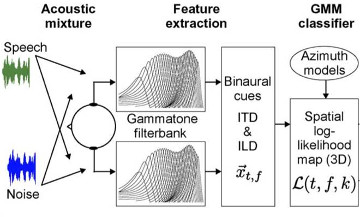
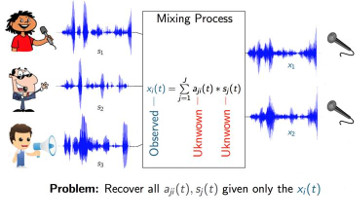
We evaluated stochastic machines on challenging Bayesian inference problems. In addition, we demonstrated the value and feasibility of stochastic computing in two applications involving the processing of low-level information from sensor signals. These applications are sound source localization and separation, as described below:
Source location:
Source separation:
Recent Developments
To locate the source, we tried various approaches, both with and without the use of the Fourier transform. The approach using the Fourier transform was presented in our paper at ICRC 2017.
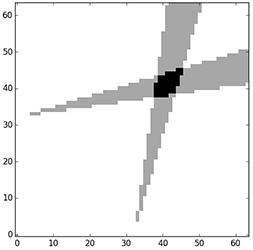
The source localization method without a Fourier transform has yielded encouraging results, as shown in the figure below. We are able to localize a source within a room (black indicates a high probability):
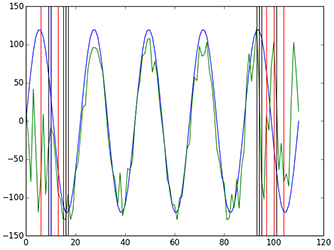
Recent work on source separation has yielded promising results. We were able to separate very simple mixed signals using the Gibbs algorithm. In this example, the sinusoidal signal was mixed with a random signal. We were able to recover the sinusoidal signal. The original source signal is shown in blue, and the reconstructed signal is shown in green.
News
- April 2019: The IEEE workshop on Emerging Technologies for Probabilistic Inference, which we organized during the INC conference, was a great success, featuring many interesting presentations. We would like to once again thank the speakers for their efforts in delivering such high-quality presentations.
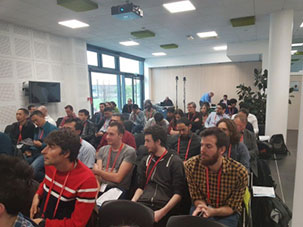
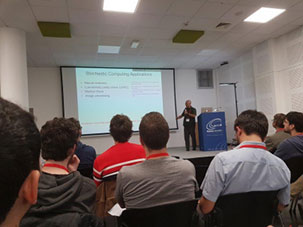
- January 2019: To kick off the new year, we are proud to announce a workshop that we are organizing as a satellite event of the International Conference on Nanodevices and Computing (INC) in Grenoble. It will take place on the afternoon of April 3, 2019, at Minatech in Grenoble. For more information, please visit: INC Homepage
- July 2018: Presentation of a paper at the 2018 IEEE International Conference on Cognitive Informatics and Cognitive Computing (ICCICC), Berkeley, CA,
- June 2018: Our Ph.D. student Raphael Frisch attended the FadeX seminar and presented a poster.
- June 2018: Our Ph.D. student Raphael Frisch attended the GDR Biocomp conference and presented a poster.
- November 2017: Presentation of our paper at the IEEE International Conference on Rebooting Computing (ICRC) in Washington, D.C.
- July 2017: Our Ph.D. student Raphael Frisch attended the 2017 PPAML Summer School in Arlington, Virginia.
Publications
Our work has been presented at various conferences:
- 2018 ICCICC: R. Frisch, M. Faix, E. Mazer, L. Fesquet, A. Lux, “A cognitive stochastic machine based on Bayesian inference: a behavioral analysis,” 2018 IEEE International Conference on Cognitive Informatics and Cognitive Computing (ICCICC), Berkeley, CA, 2018.
- 2017 ICRC: R. Frisch, R. Laurent, M. Faix, L. Girin, L. Fesquet, A. Lux, J. Droulez, P. Bessière, E. Mazer, “A Bayesian Stochastic Machine for Sound Source Localization,” 2017 IEEE International Conference on Rebooting Computing (ICRC), Washington, DC, 2017, pp. 1–8.
- 2017 IOLTS: G. Gimenez, A. Cherkaoui, R. Frisch, and L. Fesquet, “Self-timed Ring-based True Random Number Generator: Threat Model and Countermeasures,” 2017 IEEE 2nd International Verification and Security Workshop (IVSW), Thessaloniki, 2017, pp. 31–38.
Members
- Emmanuel Mazer (Director of Research, CNRS LIG)
- Laurent Girin (Professor, Grenoble-INP GIPSA-lab)
- Laurent Fesquet (Assistant Professor, Grenoble-INP TIMA)
- Didier Piau (Professor, UGA Fourier Institute)
- Raphael Frisch (Ph.D. student with a Persyval Lab fellowship)
- Marvin Faix (Postdoc with a Persyval Lab fellowship)
Download
Project presentation slides (in English) (PDF, 1.91 MB)
Project Overview (in English) (PDF, 645.34 KB)

- Share
- Partager sur Facebook
- Partager sur LinkedIn